Why Generative AI will positively disrupt Career Readiness preparation.
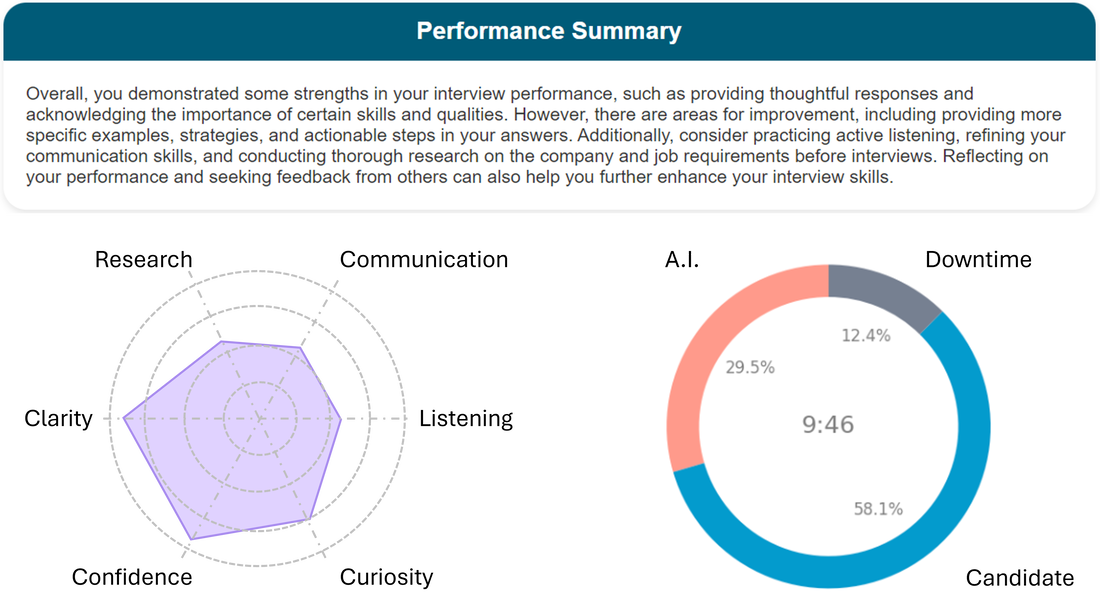
In my first blog post about Generative AI and Large Language Models (LLMs), I explained their inner workings and why they are well-suited for adoption in both academic and business contexts. I’m building on this introductory blog by diving deeper into their inner workings in specific contexts. In this second blog, I will focus on the characteristics of LLMs that make them well-suited to help with career readiness preparation, from the grassroots stage (high schools, colleges), to later in your career, when you’re ready to land your dream role at your favorite company. We’ve already seen that Large language models (LLMs) are revolutionizing various fields, including interview coaching to find your first job, college admissions preparation, and preparing for job interviews while navigating various careers (experience a demo). Their unique properties enable personalized guidance based on individual performance, making them an invaluable tool in refining the human skills needed to be successful in any career. Let’s look at some of these properties in more detail and explore the science behind “why” LLMs are so well-suited to providing personalized guidance, and what constraints must be put in place to ensure a reliable output from these models.
Advanced Natural Language Understanding
LLMs possess advanced natural language understanding capabilities, allowing them to accurately interpret interview responses. They can comprehend nuances in language, identifying strengths and weaknesses in communication skills. The best reference for Large Language Models (LLMs) possessing advanced natural language understanding capabilities to accurately interpret interview responses and identify strengths and weaknesses in communication skills can be found in the paper "Improving Language Understanding by Generative Pre-Training" by Radford and Narasimhan. This paper introduces the popular decoder-style architecture used in LLMs, focusing on pretraining via next-word prediction, which enables these models to comprehend nuances in language and exhibit advanced natural language understanding capabilities. To take advantage of this capability, it is important to provide information and context to the A.I. model that are specific to your needs. There are several ways to perform this task, ranging from few-shot learning to fine-tuning, the scope of which is beyond the scope of this blog. Courses such as these from DeepLearning.ai can be extremely useful if you are new to this field.
Adaptive Feedback Mechanisms
These models utilize adaptive feedback mechanisms to tailor coaching based on individual needs. By analyzing interview responses, LLMs can provide targeted feedback, focusing on areas requiring improvement while reinforcing strengths. To better understand the science of LLMs and their adaptive feedback mechanisms to tailor coaching based on individual needs, you can refer to the following articles:
- AdaPlanner: Adaptive Planning from Feedback with Language Models: This paper introduces a closed-loop approach that allows LLM agents to adaptively refine their plans based on environmental feedback. It discusses in-plan and out-of-plan refinement strategies, a code-style LLM prompt structure, and a skill discovery mechanism. AdaPlanner has shown superior performance in various environments, particularly with few-shot learning.
- AdaRefiner: Refining Decisions of Language Models with Adaptive Feedback: This work presents a framework designed to enhance the synergy between LLMs and Reinforcement Learning (RL) feedback. AdaRefiner includes a lightweight Adapter Language Model that refines task comprehension based on RL agents feedback, without altering the generalization abilities of LLMs, while improving decision-making capabilities in and adaptable and efficient manner.
Attention Mechanisms & Transfer Learning
LLMs leverage vast datasets to generate data-driven insights into interview performance. By comparing responses to successful interview patterns, they can offer actionable advice to enhance performance. One such dataset is the MIT Interview Dataset, which comprises 138 audio-visual recordings of mock interviews with internship-seeking students from the Massachusetts Institute of Technology (MIT). This dataset was used to predict hiring decisions and other interview-specific traits by extracting features related to non-verbal behavioral cues, linguistic skills, speaking rates, facial expressions, and head gestures. Modern day LLMs have some unique properties that allow them to exhibit similar capabilities with contextual information and new data, even if that data is not as comprehensive as the dataset described above. I briefly highlight two of these properties below:
- Attention Mechanisms: LLMs employ attention mechanisms, such as self-attention or multi-head attention, to weigh the importance of different words or phrases in interview responses. This allows them to focus on relevant information and provide more accurate feedback. In simpler terms, they consider all the words in a sentence as context and weight the importance of each word when processing another word, allowing them to discern meaning. You can read more about this in Google’s landmark paper here.
- Transfer Learning: LLMs often utilize transfer learning, where they are pre-trained on large-scale datasets for general language understanding tasks before fine-tuning on interview-specific data. This transfer of knowledge enables LLMs to leverage previously learned patterns and features, enhancing their ability to provide effective coaching by tapping into their general language understanding capability.
Real-Time Computation
One of the key strengths of LLMs is their ability to provide real-time analysis given structured data. This instantaneous feedback enables candidates to adjust their approach on the fly, improving their performance as they go. The architecture of LLMs, which are essentially complex neural networks, is optimized for efficient computation. These neural networks have already learnt a mapping between the input and output based on billions of parameters and are utilizing these learnt weights to perform mathematical computations at a rapid pace. This allows them to analyze conversational information such as interview responses in real-time, providing immediate feedback to users during these interactive sessions. Based on analysis and feedback, LLMs can help create personalized learning paths for career readiness preparation. They can even be tuned to recommend specific resources or exercises tailored to target areas for improvement, thereby maximizing their effectiveness.
How can Generative AI help my organization with career readiness?
In conclusion, the properties of large language models make them exceptionally well-suited for providing personalized career readiness preparation. Their advanced natural language understanding, adaptive learning mechanisms, data-driven insights and real-time computation capabilities offer invaluable support to individuals navigating the complexities of the pursuing their career goals. As LLMs continue to evolve, they hold the potential to revolutionize career development, empowering individuals to achieve their professional goals with confidence and competence. The reliability and consistency of the output from these LLMs is however heavily dependent on the quality of your input data and the precise definition of context that you can provide. At Relativ, we help organizations gather input data and create guidelines with sufficient fidelity for their A.I. models to infer “what good looks like”. We help them experiment with their own data and understand how an LLM works with different contextual information, so they can expand these capabilities and begin to measure various skills that individuals exhibit during their conversational exchanges. When tailored to specific job descriptions, these customized A.I. models can give end users a competitive advantage by not only identifying the skills they require, but also helping them improve their performance on those skills through personalized feedback. Head over to relativ.ai or reach out to us to learn how we can help you deploy your own AI models, infused with psychology, and linguistics, to empower your organization and end users with the career readiness skills they require to meet the challenges of the future of work.