How AI Coaching is Turning Sales Enablement Firms into Product Companies
I have been speaking to founders of small sales enablement firms who all say something similar that has stuck with me, as I continue to build Relativ with my amazing team.
We deliver incredible workshops. We have massive labels - you'd know every brand we work with. The feedback is always great. But we have no idea how we would ever do this for ten times the number of clients and hundreds of end users without breaking our business. And we know AI is killing us.
Now bear in mind, this is never said dramatically - it is always calm, and almost sounds like they're resigned to the reality of AI displacing (or at least disrupting) their work. And this is what makes it really interesting and fuels me to keep building Relativ. People recognize that the environment around them has already started to shift, and the old way of operating simply isn’t going to stretch much further. A lot of the sales enablement industry quietly sits in this very space right now.
About 3 weeks ago, I was speaking with another training provider who works with enterprise sales teams in regulated industries. They had just come out of a pitch with a large client. Two thousand leaders needed training. The expectation was not just training. It was measurable improvement. Skill progression. Proof that behavior was changing in a way the client could track over time. Their answer was honest:
About 3 weeks ago, I was speaking with another training provider who works with enterprise sales teams in regulated industries. They had just come out of a pitch with a large client. Two thousand leaders needed training. The expectation was not just training. It was measurable improvement. Skill progression. Proof that behavior was changing in a way the client could track over time. Their answer was honest:
"We have strong satisfaction scores."
And in that moment, you could feel the gap open up between what was being asked and what could actually be shown. Because satisfaction is not the same as capability. And everyone in that room knew it.
This is where something important becomes visible. Sales enablement firms are not actually in the business of delivering workshops. They are in the business of changing behavior at scale. But behavior change has always been expensive to measure. It requires observation, repetition, feedback, and time. So instead, the industry optimized for proxies. Attendance. Engagement. Feedback forms. It worked well enough for a long time. But now those proxies are starting to feel fragile. Not because they stopped working but because the expectations around them have changed faster than the systems behind them.
The shift becomes clearer when you look at what is actually being asked of these firms today. Enterprise buyers are no longer evaluating training providers based on how engaging a workshop feels or how polished a facilitator is in the room. They are evaluating whether behavior inside their revenue teams is improving in a way that can be observed, repeated, and eventually tied back to business outcomes. In practice, this means the conversation is moving away from delivery quality and toward proof of capability change over time. That is a fundamentally different expectation, even if it is not always stated explicitly.
What makes this difficult is that most enablement firms are already doing the hard part of the work. They define what good looks like in a sales conversation. They design the frameworks. They run the roleplays. They sit in on live interactions and give feedback. The missing piece is not expertise. It is continuity. There is no persistent system that allows that expertise to extend beyond the room, beyond the workshop, and into the daily repetition of real sales behavior.
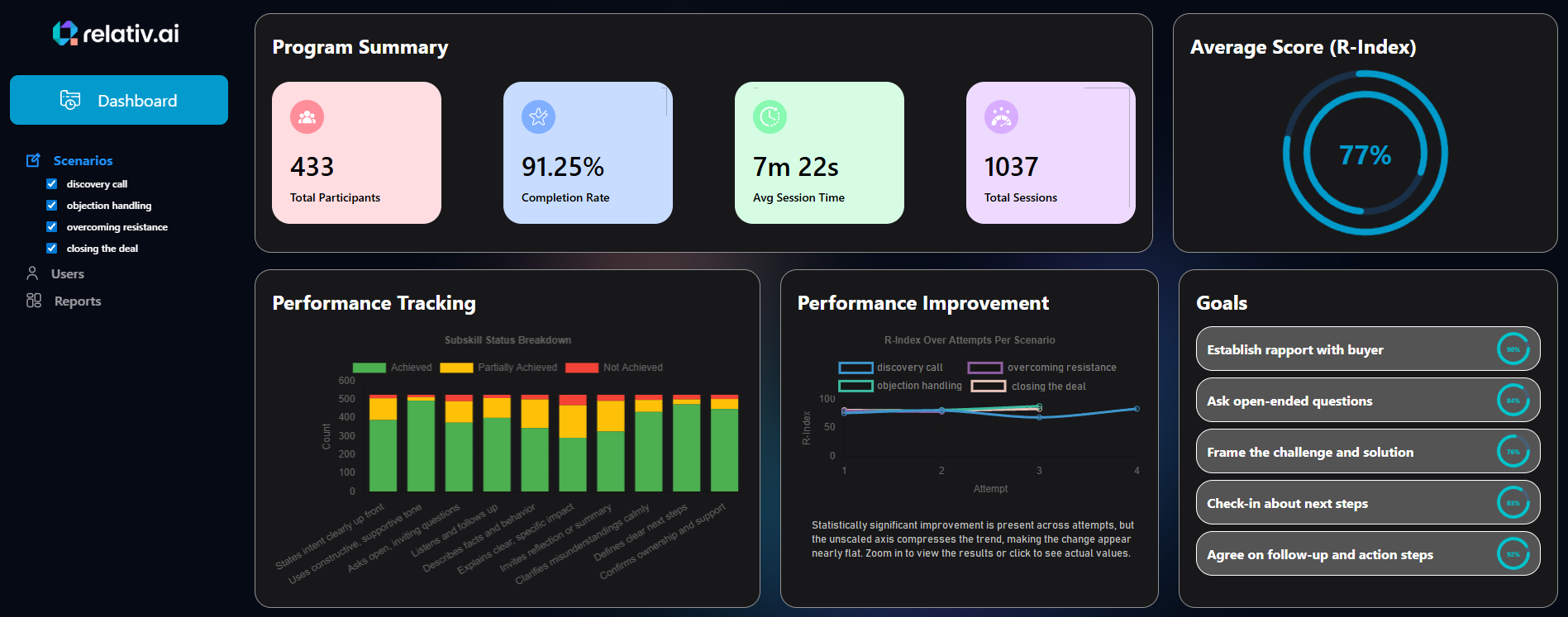
This is where AI begins to change the shape of the problem, not by replacing the existing model, but by converting it into something that behaves more like a product than a service. Sales enablement firms do not lose their frameworks, methodologies, or coaching expertise - in fact, those become the most valuable part of the system. What changes is the delivery mechanism. Instead of being delivered only through human-led sessions, those frameworks are encoded into AI-driven practice environments where conversations, objections, and leadership scenarios can be simulated at scale. In effect, the “product” becomes the continuous application of expert judgment, rather than the hours of a facilitator.
From a technical perspective, this shift is made possible by transformer-based language models that excel at maintaining context across multi-turn conversational sequences. In practical terms, this allows realistic simulation of sales and leadership interactions where the model can generate responses conditioned on role, tone, objection type, and historical context. When combined with a well-designed retrieval system (embedding-based retrieval), a firm’s thought leadership, point of view, and coaching frameworks can directly inform how the AI coaches - allowing it to consistently evaluate whether a rep’s response aligns with defined behavioral standards across thousands of interactions. This turns previously subjective coaching moments into structured, comparable signals. For example, a firm that previously relied on live roleplay sessions for 50–100 participants per cycle can now extend that same coaching logic across thousands of simulated practice sessions without increasing marginal coaching effort in proportion.
Once this layer is in place, the business model begins to shift in a very specific way. What was once sold as time-bound workshops or coaching retainers becomes a structured AI-enabled enablement system licensed across cohorts or seats, often bundled with existing training programs. Instead of revenue being tied to hours delivered, it begins to resemble access to a continuously running capability layer. Margins expand not because pricing increases, but because the marginal cost of additional “practice interactions” trends toward infrastructure cost rather than human labor. In practice, firms move from selling delivery capacity to selling ongoing performance systems, where value is expressed through sustained skill progression, measurable behavioral change, and the ability to support far larger cohorts without linear increases in coaching headcount. Over time, this is what defines the transition from a service business into a product company - not just the addition of AI features, but a reconfiguration of how value is delivered, scaled, and monetized. This enables a fundamental shift toward subscription revenue, with a deeper client footprint, and a more persistent presence inside the organizations they serve.
If you are in sales enablement and want to tap into AI, (or know someone else who may want to), without having to invest in expensive and time-consuming building, head over to our website at relativ.ai or reach out to us so we can help you harness the power of an AI engine to scale your business.